interview at off the wall magazine
*How and why did you became a photographer ?
-I was a journalism student at the university and my first introduction with photography was in the classes about the history of photojournalism. So more than the practice of it first I got interested in photography with looking at the historical and iconic images. I still think (regardless to your style) history of photography is important for a photographer/artist to be aware of the capacity of the medium. During the same time I was playing with some small cameras, and I learnt how to use it. With the help of my study I had the chance to intern in some newspapers more like a hot spot photographer doing small daily assignments and it didn't took so long for me to understand it's not what I want if I want to go on in photography. It was during a course I had in Sweden I understood that it can be a different form of language, a visual language and you can use that as a tool of expressing yourself.
*Do you remember the first image you took ?
-The first images i made were very simple staff; photographs of a cat playing on the floor and silhouette of people walking by the sunset and flowers in my balcony. I still like these pictures!
*Do you think that photography is art ? Did you ever feel like an artist yourself ?
-It can be! Why not? Photography is just what you make of it. There's not one concrete photography; It's a tool, just a camera and you can do whatever you like with it; You can use it for scientific reasons (by the way NASA has a great collection on their website) or to document things for the newspapers or to sell products like in advertising photography! Regarding to what i do; i don't know; i'm not sure and it's not really important if i'm doing art or not. But i just want to make it good of what i'm doing. I think that's more important than trying to define it. The others or the audience and critics can decide if it's really art or something else; But maybe it's just simply photography!
*How do you know when the picture is "good" ?
-The “good” image is very relative for any photographer and it's also important how and where you use that image; in which context; There's some images that i don't like to exhibit on the walls of a gallery but in the form of a book that image may fit perfectly in the sequence because it gets together very well with the image just before or after. But still for me to choose the “good” photograph is a very intuitive process; the right elements is either there or not, the image either invites you or you just skip that image.
*You used to photograph Istanbul. What kind of relationship do you have with this city ?
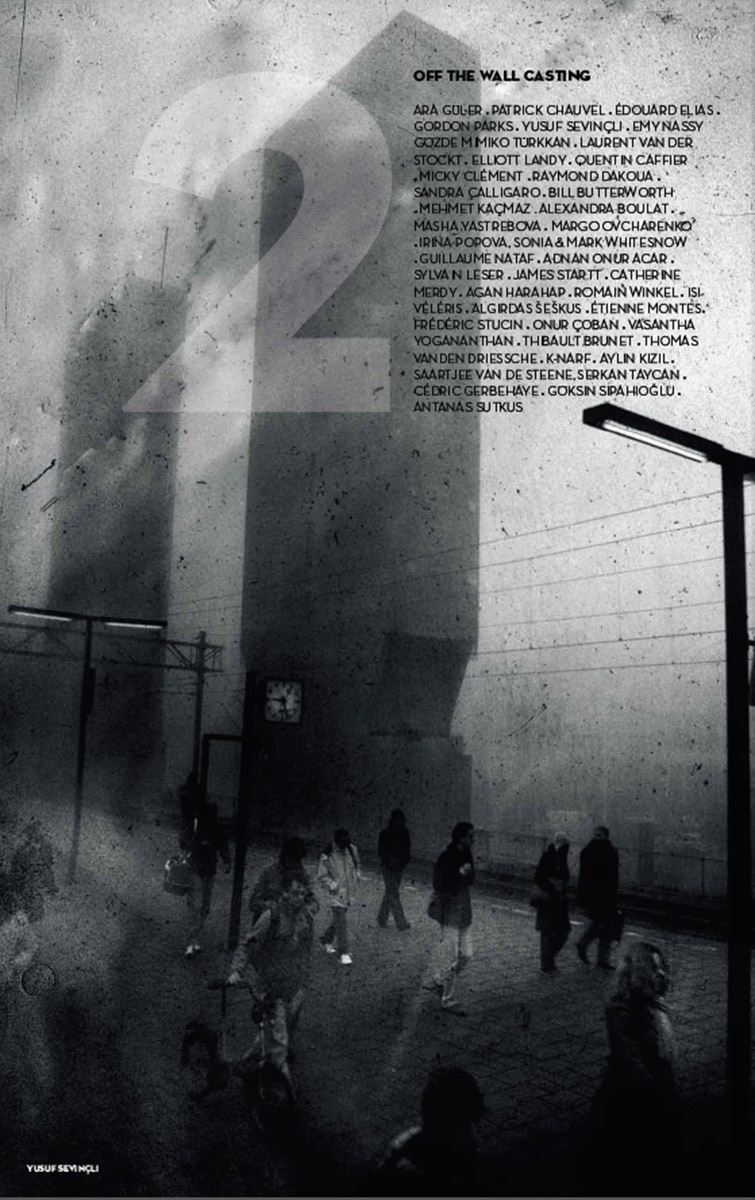
I don't photograph istanbul- But i usually photograph in Istanbul; That makes a big difference. I make photographs in Istanbul because it's the place that i live and i know best; i know its history and inhabitants of this town, I know each corner of each street by heart. I've been living here for long time and i can identify myself the best with the feeling of this town. After living in here for long years i still find it chaotic and beautiful. It's a big and multilayered city because it's growing and developing organically by the hands of its inhabitants without a plan unlike in Europe i think. But i don't like to make a work about the city itself but i use the city of istanbul as the background for my work.
*The texture of your images refers to a kind of nostalgia. Why ?
Well, I don't agree with you! Maybe its just because the term 'nostalgia' doesn't sound good to me. I think there's certainly an issue of 'time' in my works (I love Proust!) But i can't explain it. And the texture of my photographs just come naturally, it's not an esthetic choice, it's not on purpose. But i think it fits to my photographs because the texture is the traces, it adds some kind of personal touch and thickness and volume. Texture is the spices of my work!
*I've red several times the word "poetry" attached to the description of your photos. Do you agree?
Thats what i like to have in my works and I can take that as a compliment! Maybe it's because usually my works doesn't have a certain subject that you can define literally and it's the same in some kind of poetry; I want to keep the meaning open, i want the viewers to make their own interpretation, i don't want to dictate the whole story or feeling in my works.
*You're best known for your work in black and white. Why do you photograph more in black and white than color?
There's two reasons for that; First; technically its much more simple to work in bw than in color and when you keep the image more simple they get more powerful. Second; That you can put more feelings in bw images; it has the effect of getting inside the veins of the audience, it can be almost hallucinating.
*You travelled a lot. What do the trips bring to your photography ?
I think traveling and meeting with many different people gives you the capability of having empathy with people. Maybe you don't become a part of the lifes of these people you meet but you experience something together and that brings an awareness of the human conditions which is very important to have empathy for the others. That's a big contribution for my photography i guess.
*Does is exist an Ara Güler's heritage for young photographers ?
Certainly there's an heritage of Ara Güler in Turkey; not only for young photographers but for the cultural life in Turkey. The history of visual arts is different than the western world in here; so to say visual arts was less established until a certain period of time... So without his images there could be a big gap in the visual memory from both Istanbul and Turkey. There's several artists, well known writers and important politicians who are photographed only by Ara Guler from the 50s and 60s. Now we are looking at his photographs to understand the conditions of daily life in istanbul because there's not too many visual records from that period. And many of his iconic images are so powerful which reflects the soul of this time. Thats why his images have become an important part of the collective memory.
*Can you comment this Ara Güler's sentence : "Photography is nothing's more than reality" ?
Of course every statement should be considered in the right context and of it's time. According to Ara Guler and his generation; so to say humanistic photography, Magnum generation,etc i can understand this sentence. And i think medium of photography had a great impact on our civilization in the 20th century in the service of documenting/witnessing the history and reality. And still today a big group of photographers are coming from the tradition of photographers who considers photography just reality. On the other hand times are changing, everything is changing from music to fashion. So why photography should be frozen? I think now it can be more than just reality- or maybe less. The medium itself has an endless capacity, and waiting for us to explore it.