Group Show at Arter, istanbul
The Aesthetics of Subliminal Perception
Yusuf Sevinçli typically takes photographs in the dark. This suggests a desire on his part to use the lens to see something which is not readily visible. It is an attempt to capture what is not seen, what is yet to be seen, what lurks behind in the dark. This holds true for photographs taken in the light as well. In his newly produced series, Sevinçli hovers around sculptures and monuments in public spaces – particularly those that have been ‘vandalised’. Hovers, as opposed to focuses on, because the subject matter of his work is quintessentially out of focus, decentered, and depend on a peripheral vision which bestows upon it a subliminal sense of perception. It is this subliminal perception that opens up the grounds of the ruminations to follow.
Looking back to the history of what seems to be the subject matter of these photographs, one can trace a struggle for power in the production, placement and fate of sculptures and monuments in public spaces. Sevinçli follows this tension in various cities in Turkey with photographs from Adana, Ankara, Bingöl, Diyarbakır, Erzurum, İstanbul and İzmir. However despite this research based approach, the photographs are not documentary in style. On the contrary, the object always seems to have entered the frame serendipitously; as a reflection in a puddle of water, in the corner of a massive sky, out of a pitch black night. What lies within these uncanny images is a glimpse into the struggle embodied by the visibility and invisibility of these objects.
According to Jacques Ranciere, the extent to which art is political, beyond its content, is about what he defines as the distribution of the sensible. “Art is not political because it deals with political matters or represents social and political conflicts. It is political first because it reframes the distribution of space, its visibility and habitability”. What Sevinçli captures in these photographs is not necessarily the content or theme of these sculptures and monuments, nor their destruction or modification, but the struggle to reframe public ‘space’ – a struggle that is fought upon them.
One such example, in which contemporary art practice also claims a stake, is Hafriyat Collective’s experience with the Worker’s Monument in Tophane. Erected in 1973 as one of twenty ‘civil statues and monuments’ commissioned by the CHP, the monument went through an everlasting transformation throughout its existence. Meltem Ahıska describes the process in the essay in which she traces the story of the Worker’s Monument: “First the fingers, then the sledgehammer, then the arm was broken; the face was covered with tar, and finally the face was completely destroyed. The artist repaired the monument several times, but the attacks were insistent, and after a while it was left to stand in that crippled way to be further worn down by environmental conditions”.
On the evening of September 21st, 2010 Hafriyat artists’ collective, left their space in Karaköy and walked to the park in Tophane to attempt to steal the Worker’s Monument, long invisible, and damaged to the point of being unrecognizable. They did not know what would come of their action, but they had several scenarios in mind. Most probably no one would notice, or perhaps the police would come, they would be sued by the officials and they would keep records of this. In any case, it was to be an intervention aimed at making this long forgotten presence visible again –whether through conflict, legal action or making the news. What happened was the least expected scenario.
When the residents of Tophane intervened and re-claimed the Worker’s Monument it was dark outside. However, not only was the monument made visible again, but a whole new aspect of its meaning was uncovered. The locals referred to it as the ‘stone’ –calling it as it is- which stripped it of its previously intended official meaning. Ahıska goes on to infer that, among other things, “it is possible that the locals of Tophane may be embracing the ‘stone’ for strengthening their ties with the place, especially with the fear of displacement evoked by the recent transformations in the neighborhood.”
The incident is revelatory on several accounts as to how the sensible is distributed and redistributed in public space. First and foremost, the monument appears as a modernist construction that is imposed into public space, framing it from an official point of view. Even though the Worker’s Monument is part of a well inteded gesture for placing ‘civil’ sculptures and monuments, or even art in public space, it nonetheless ends up denoting an authority and an ideological battleground –be it leftist, statist or nationalist.
The rejection of this modernist construction manifests itself in different forms, most violently on “civil sculptures” such as the Worker’s Monument since others like the busts of Atatürk is protected against intervention and ‘vandalism’ by law. While the initial motivation behind Hafriyat’s action, at least partly, seems to be based upon a modernist assumption that the workers monument was abandoned by the community and needed to be rescued; the intervention itself ended up revealing an already ongoing re-distribution of the sensible.
What is negotiated here is space, but even further, what is deemed possible in space, and with art. It seems that in terms of the distribution of the sensible, the sculptures and monuments in public space and following acts on, toward and against them are, to a certain extent, two sides of a coin engaged in a constant struggle for space and its meaning.
Sevinçli’s enigmatic photographs enables us to glimpse at the possibility of the multiple ways of negotiation and reappropriation that this struggle entails. Their oblique angles and quality of darkness reveal vantage points that operate outside of hierarchical structures of official discourses. While it’s subject matter is never readily and plainly visible, the photographs are also partly perplexing in terms of their intended statement. It could be that, to some, these photographs will speak with outrage at vandalism, to others with nostalgia. A horses head that breaks out of the darkness might conjure up Picasso’s Guernica, while a landscape might recall a haunting history.
Unlike an action, photography doesn’t necessarily intervene or change the stage. It typically only documents. But Sevinçli’s work goes beyond documentation of what is visible. What it captures exceeds what the photographer wishes to preserve from what he can already see, into what he can only intuitively sense. The darkness, that sometimes literally and sometimes otherwise set the scene for these shots is perhaps one way in which these photographs are active: They produce unintended consequences, cut through the dark and render visible what is not readily in sight, thus allwoing us the possibility to glimpse at something unexpected
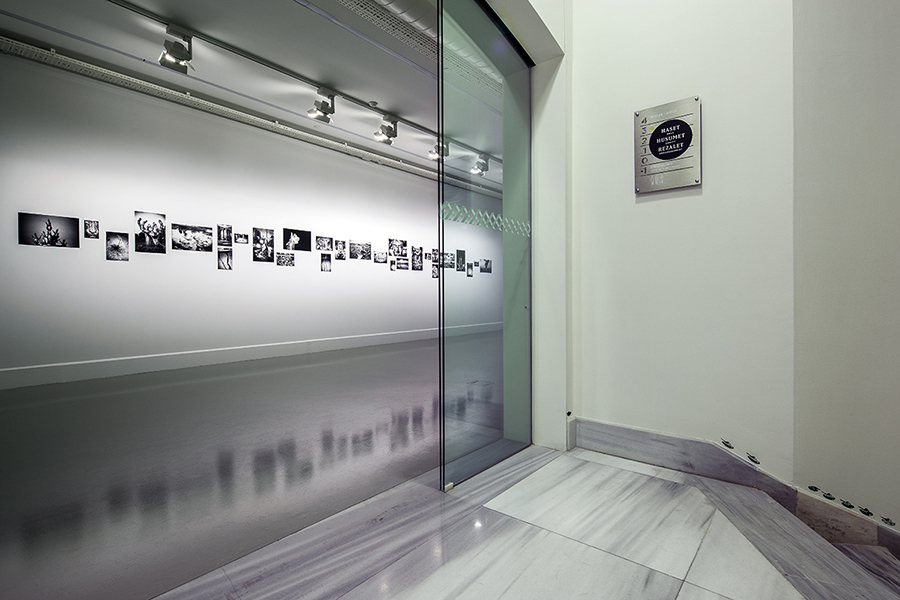
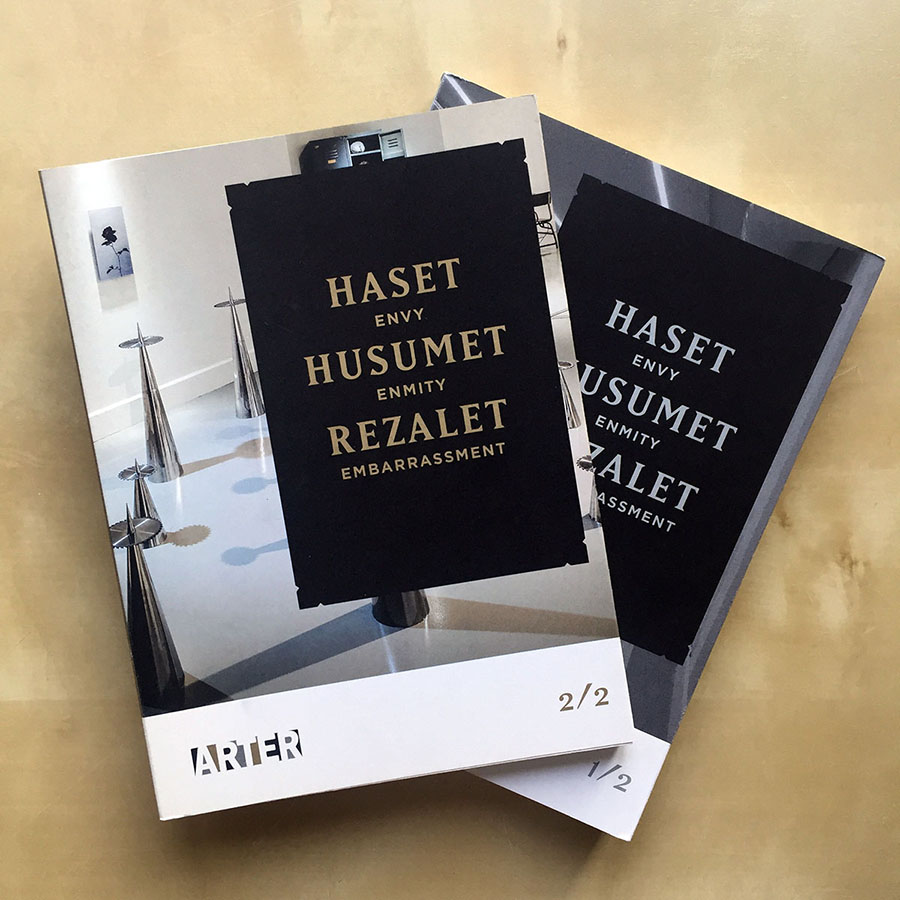
Group Show; Envy, Enmity, Embarassment at Arter, Istanbul,
24.01 - 7.05. 2013
"Envy, Enmity, Embarrassment" was the second in the exhibition series that focuses on new productions scheduled to take place annually in Arter's programme. The three terms brought together in the title of the exhibition are used as keywords for expressing social, cultural and political memory within contemporary artistic discourse and initiate an intellectual process resulting in the creation and production of a series of new works. The exhibition aimed to explore these three interconnected concepts that precede, follow and complete each other in a broad web of causality, in a wide perspective that incorporates diverse contexts ranging from political and social violence to the media; from careerist concerns and ambitions to gender politics; from potentialities of "friendship" and "solidarity" to "aggressive" and "destructive" drives.
In a world where hostility and conflicts between individuals and nations are deliberately provoked and war has become universalised, "Envy, Enmity, Embarrassment" questioned the capacity of mankind to nourish and stage prospects of "friendship", "solidarity" and "co-existence" as well as "hostility", "greed for power" and "discrimination". While revisiting—although partially—the recent collective history, the exhibition explored destructive feelings—which we cautiously conceal and keep silenced as they are harmful not only to others but also to ourselves—as well as the traumas associated with them.