Gente di fotografia Magazine, may 2017
Yusuf Sevinçli
Pietà eroica
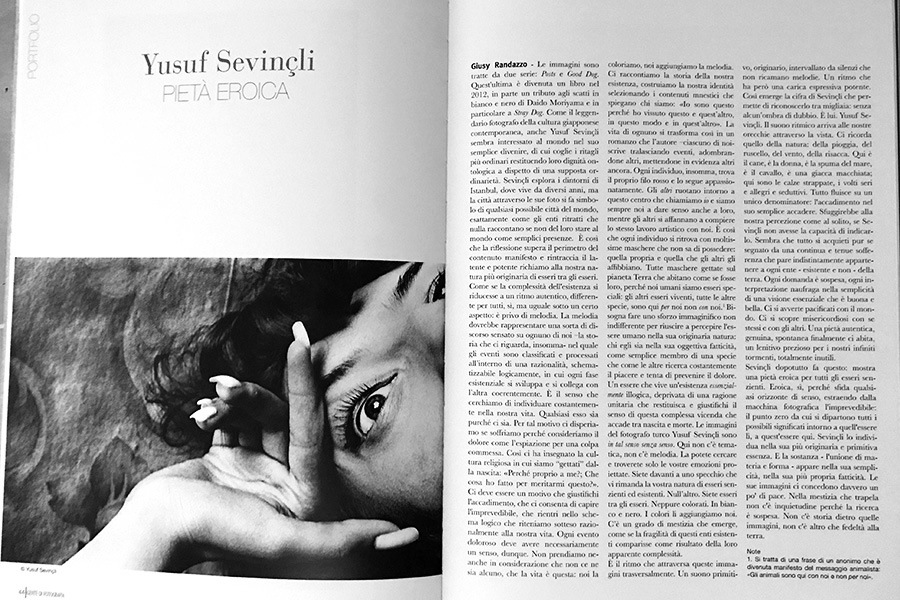
The images are taken from two series: Post and Good Dog. The latter was made into a book in 2012, in part a tribute to the black and white shots of Daido Moriyama and in particular to Stray Dog. Like the legendary photographer of contemporary Japanese culture, even Yusuf Sevinçli seems interested in the simple progress of the world, which takes the most ordinary off cuts and restores their ontological dignity in spite of a supposed ordinariness. Sevinçli explores the areas around Istanbul, where he has lived for several years, but through his photos the city becomes a symbol for any possible city in the world, just like his portraits of figures which tell us nothing if not of their being in the world as mere presences. It is in this way that the reflection exceeds the perimeter of the content and tracks the latent and powerful reminder of our most original nature of being among beings. As if the complexity of existence is reduced to an unwavering rhythm, different for everyone, yes, but alike in one respect: it is devoid of melody. The melody should be a kind of reasonable discussion about each of us, the story that concerns us, in which events are recorded and processed in a logically outlined rationality, in which every existential phase develops and connects consistently with the other. It is this reason which we try to constantly identify in our lives. Any being is present provided that they are present. For this reason we despair if we suffer because we consider pain as an atonement for a wrong committed. It is what religious culture has taught us in which we are "thrown into" from birth: “Why me? What have I done to deserve this?” There must be a reason to justify the occurrence, which allows us to understand the unpredictable, which falls in the logical pattern that we believe rationally underlies our lives. Every painful event must necessarily have a sense, then. We do not even consider that there may be none, that life is this: we give it colour, we add the melody. We tell ourselves the story of our existence, we build our identities by selecting the mnemonic content that explains who we are, "I am this because I have experienced this and that, in this way and that." Everyone's life is thus transformed into a novel that the author, each one of us, writes ignoring events, shading or highlighting others. Everyone, in fact, finds their own common thread and follows it passionately. Others revolve around this centre that we call I and it is always us to give meaning even to them, while others are scrambling to make the same artistic work with us. This is why every individual is left with many masks which they do not know they possess: their own one and the one which others give to them. All these masks thrown on the planet Earth which live as if they are them, because we humans are special beings; the other living beings, all other species, are here for us not with us. We must make a considerable imaginative effort, not be indifferent, to be able to perceive the human being in its original nature: who we are in our objective facticity, as a simple member of a species that like others search constantly for pleasure and try to prevent pain. A being that lives an essentially illogical life, deprived of a unitary reason that gives back and justifies the sense of this complex story that happens between birth and death. The images of Turkish photographer Yusuf Sevinçli are in this way without sense. Here there is no theme, there is no melody. You can try to look for one but you will only find your projected emotions. You are in front of a mirror which reflects back your nature as sentient and existent beings. Nothing else. You are beings among beings. Not even colourful, but in black and white. We add the colours ourselves. There is a degree of sadness that emerges, as if the fragility of these existing entities appears as a result of their apparent complexity.
It is the rhythm which runs transversally through these images. A primitive sound, original, punctuated by silences that do not embroider melodies. A rhythm that has, however, a powerful emotional charge. This is how Sevinçli’s style emerges and allows you to recognize him among thousands: without any shadow of a doubt. It is him. Yusuf Sevinçli. The rhythmic sound reaches our ears through our sight. It reminds us of nature: the rain, the stream, the wind, the surf. Here is the dog and here is the woman, the foam of the sea, the horse, a stained jacket; here are the torn stockings, their faces serious and playful and seductive. Everything flows on a common denominator: an event simply happening. It would escape our perception as usual, if Sevinçli did not have the ability to indicate this. It seems that everything will calm down even though marked by a continuous and subtle suffering that seems to vaguely belong to each entity, existing and not, of the earth. Each question is suspended in the air; every interpretation is shipwrecked in the simplicity of an essential vision that is good and beautiful. There is a feeling of being at peace with the world. Of feeling merciful towards yourself and others. An authentic, genuine and spontaneous compassion is finally present, a valuable soothing medicine for our endless and totally unnecessary torments.
Sevinçli, after all, does this: he shows a heroic compassion for all sentient beings. Heroic, yes, because it challenges any horizon of meaning, extracting the unpredictable from the camera: the zero point from which depart all possible meanings regarding that being there, this being here. Sevinçli finds it in its purest and most primitive essence. And the substance, the union of matter and form, appears in its simplicity, in its own facticity. His images really do allow us a bit of peace. In the sadness that seeps out there is no anxiety because the search is suspended. There is no story behind those images; there is nothing but loyalty to the land.
Giuseppe Randazzo