Book review; Monuments of Unoffical Power
Monuments of Unofficial Power
In a recent photobook, Put, Yusuf Sevinçli investigates people's urge to express themselves through destruction of symbols.
Sequencing is inherent to photography. Juxtaposition and accumulation charge images with meaning, multiplying the variety of interpretations of a single frame. In his latest book - a publication made from a series shot in 2012 as part of a group exhibition at Arter, in Istanbul - Yusuf Sevinçli deploys the power of such an apparatus.
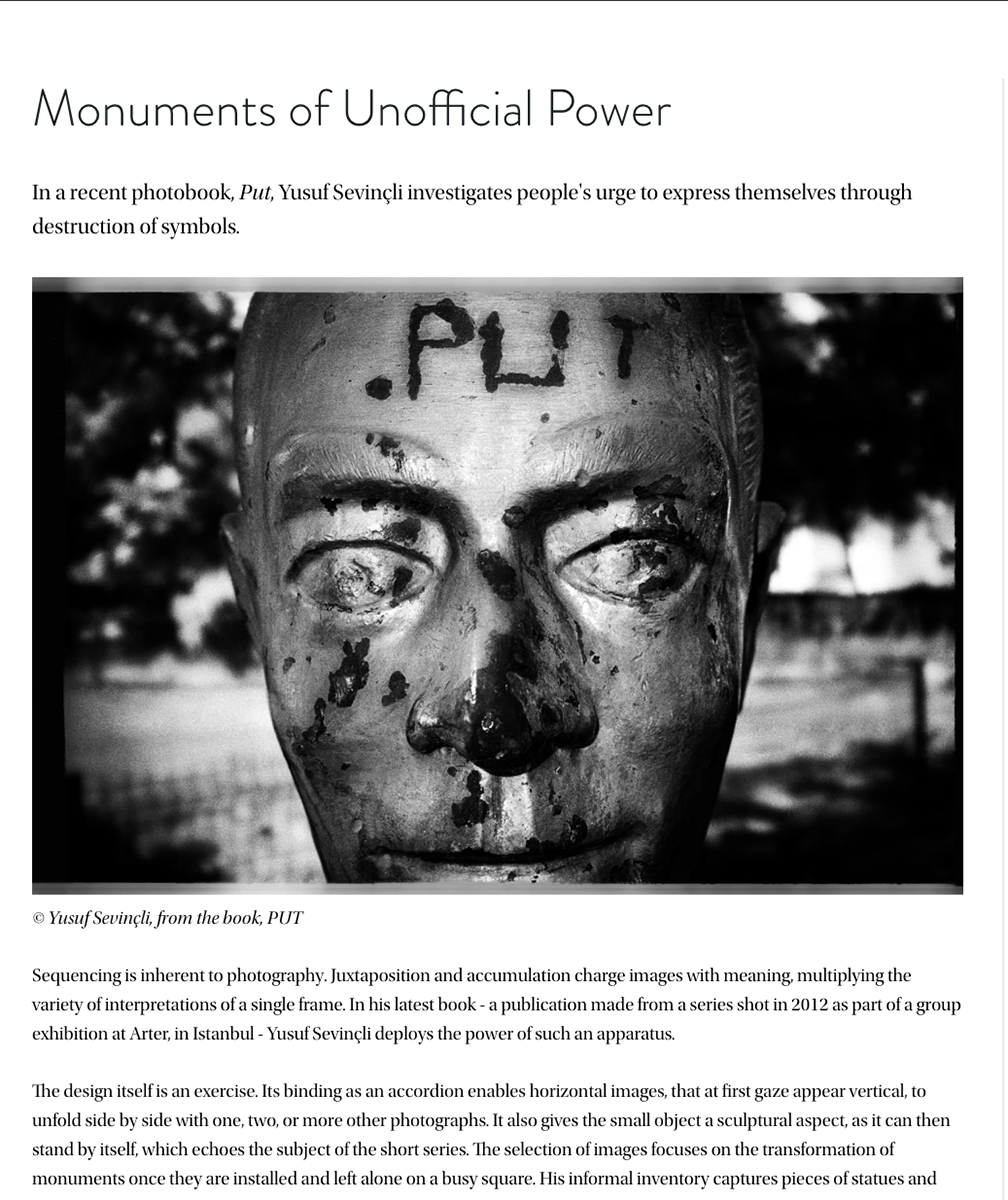
The design itself is an exercise. Its binding as an accordion enables horizontal images, that at first gaze appear vertical, to unfold side by side with one, two, or more other photographs. It also gives the small object a sculptural aspect, as it can then stand by itself, which echoes the subject of the short series. The selection of images focuses on the transformation of monuments once they are installed and left alone on a busy square. His informal inventory captures pieces of statues and walls, covered with graffiti, teared apart or dismantled.
As Lara Fresco, who wrote an introduction to the work in 2013 puts it, “what lies within these uncanny images is a glimpse into the struggle embodied by the visibility and invisibility of these objects. […] Their oblique angles and quality of darkness reveal vantage points that operate outside of hierarchical structures of official discourses.” The title of the book, inspired by a word painted on the forehead of Ataturk’s statue, revealingly means “Idol”. In a country where an artist had tried to compile in thousands of images all the appearances of Atatuk in Turkey in a database playfully called “Atabase”, Sevincli’s series offers an interesting perspective on the omnipresence of social and political symbols.
And this, especially since he varies the points of view. He first observes the damaged monuments in a dark black and white that charges them with an unsettling aura as the scale is never obvious, before going on to capture the executioners, such as people gathered around a fire. Another photograph disturbingly seems to represent a man reading how to break a cracked window with an axe.
Only one horse seems to protest this shared fate. His mouth open in distress and his head dripping with what could well be blood, he resembles a typical figure of classical war frescos. A timeless character, it echoes what Nilufer Sasmazer wrote in the postscript of the book: “Whichever authority or ideology they represent, these sculptures, each with its own separate story, share a similar destiny, and their paths intersect in the same story.”
By Laurence Cornet at PHMuseum.com